
Nebula - The project name for one of Litera’s generative AI enhancements searching for firm precedent in a secure Azure environment.
Background
With the huge disruption to our industry AI was impacting our business in a big way. HG, our owner, identified Litera as their most impacted business by the generative AI wave. They acted fast and a leadership team identified use cases and prioritised which of their 16 core products would benefit most. Nebula was one of 3 projects given the go-ahead. It was built on top of an existing incubator product; Litera Recommend Service allowing a much faster path to MVP.
Objective
To fully explore the opportunities of generative AI, LLMs, vector databases and more we set up 3 small teams to act as startups dedicated to researching, building and shipping products fast to showcase at the annual ILTACON lawyer conference. Nebula was one of these products and teams. Specifically positioned in the document creation space, it's primary goal was to find relevant company precedent, in documents, clauses and definitions.
My Role
I was placed into a multidisciplinary team which worked incredibly well, delivering an MVP within 3 months. We were able to impress many customers with Nebula AI at the ILTACON conference. Designing in a fluid and fast moving way is often not ideal but we were able to run design critiques within my team often and Litera is fortunate to have many Legal Knowledge Experts we can validate our decisions and test our prototypes on. I was responsible for much of this work. What an exciting time to be a designer!
The Challenge
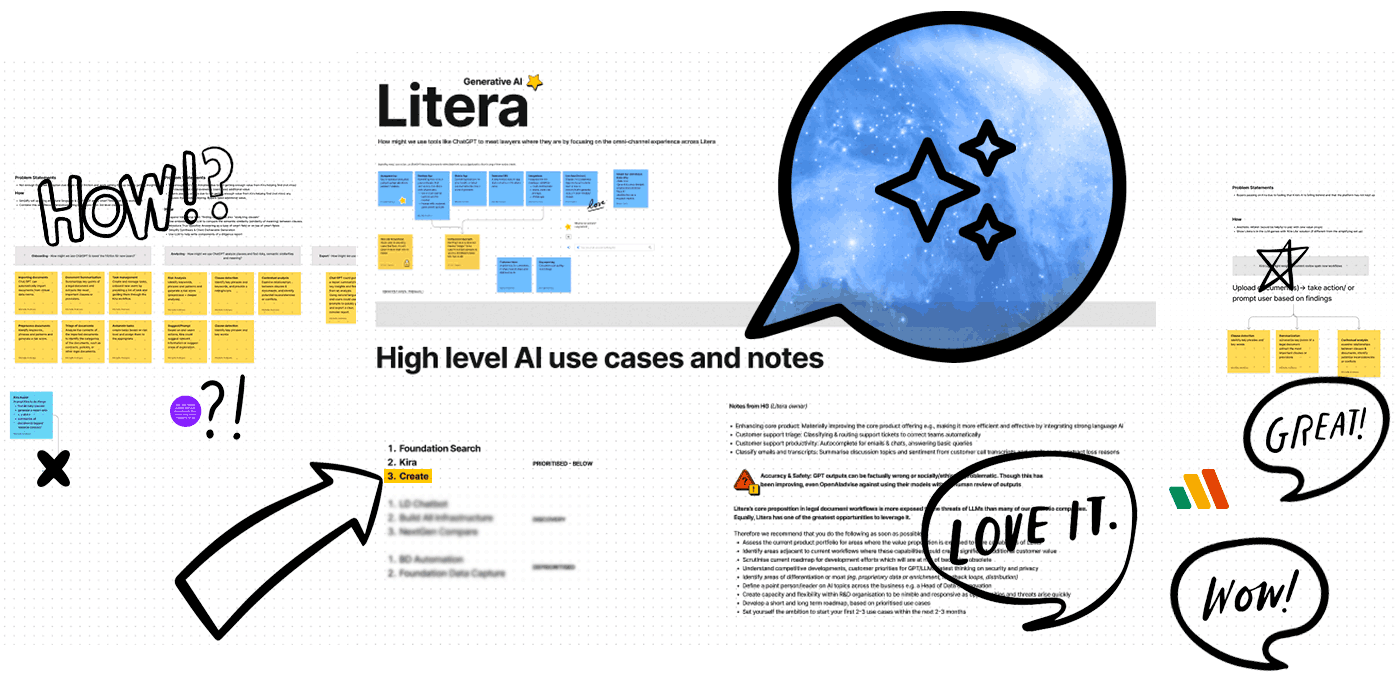
How could Litera remain competitive and rise up in response to the AI revolution that had gripped the technology and legal space? As a design team we conducted design sprint exercises to understand this new space and work on how we might design for this new functionality. With designers embedded into the 3 teams building new products or enhancements. We met regularly to share learnings and remain flexible to the changing landscape. Multiple knowledge sharing sessions were held and design patterns explored widely and tested out in Figma and then moved into production in a regular 2 week sprint cadence.
The Outcome
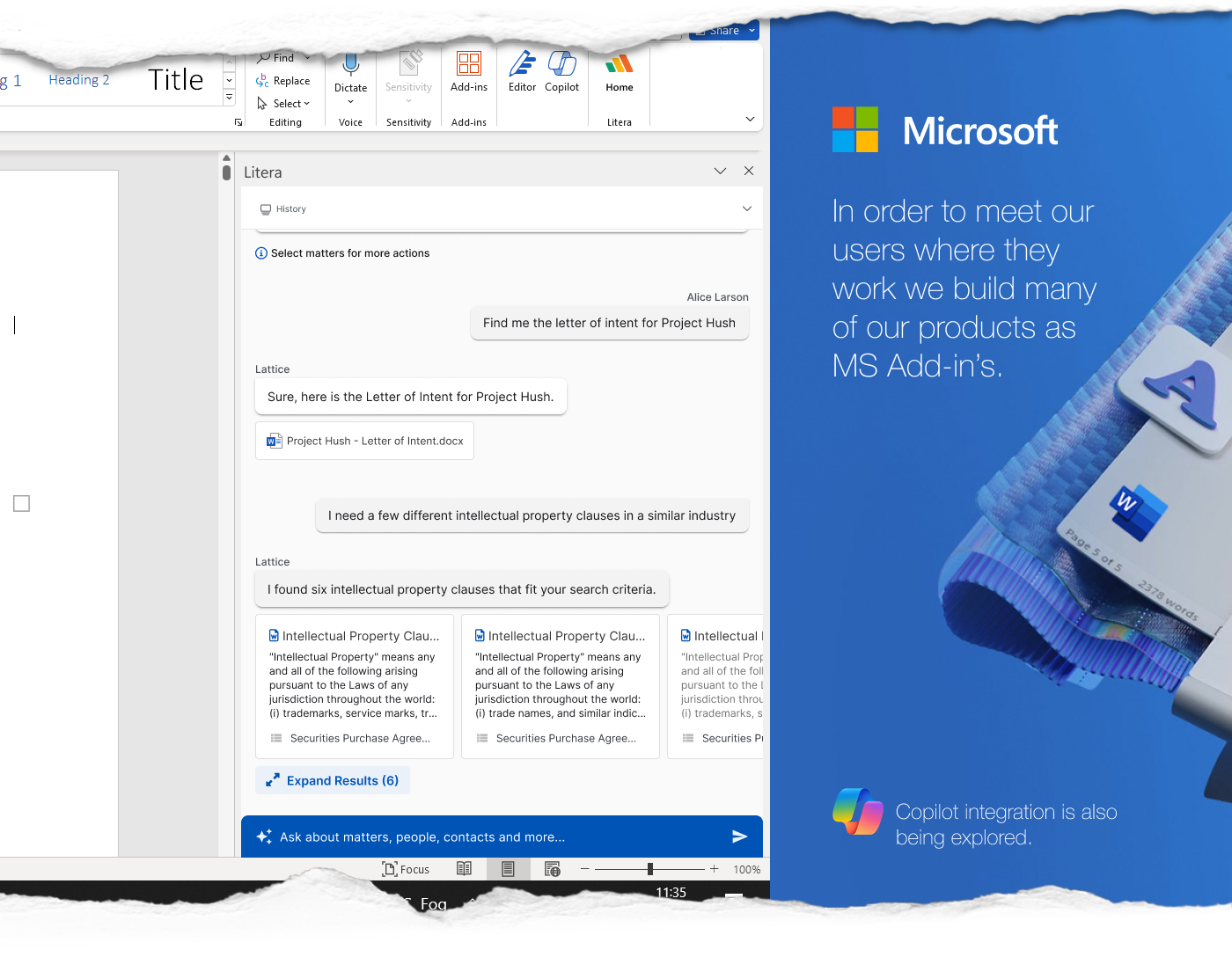
Litera Create-Content AI is a Microsoft 365 web app which seamlessly integrates with Azure Open AI and GPT-4. Ensuring users can perform natural language queries to surface clauses, definitions, and contract information to insert into their documents without ever leaving Microsoft Word. It delivers incredible accuracy searching firm precedent content using Litera's trained LLM.
Litera are beta testing all their new AI projects with great success and praise from the law firms participating.
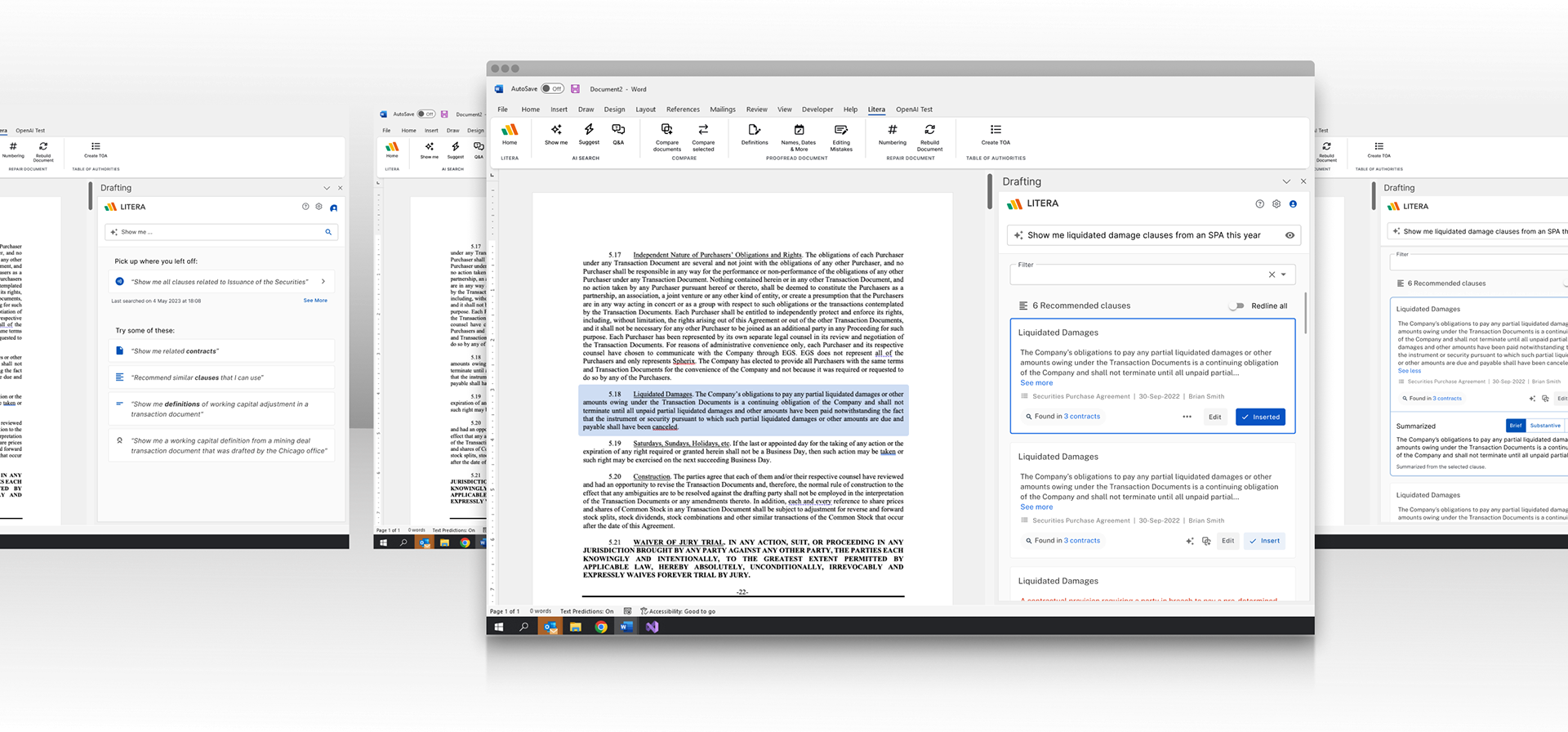
2024 Litera is focused on delivering a new cloud based drafting add-in for Word. The add-in will feature a full suite of products including a new AI enabled Q&A chat experience seen below. As a design team we are constantly looking for ways to leverage and embed this new technology to help streamline and simplify our users workflows. Accessing multiple data sources through a central chat experience is also being worked on.
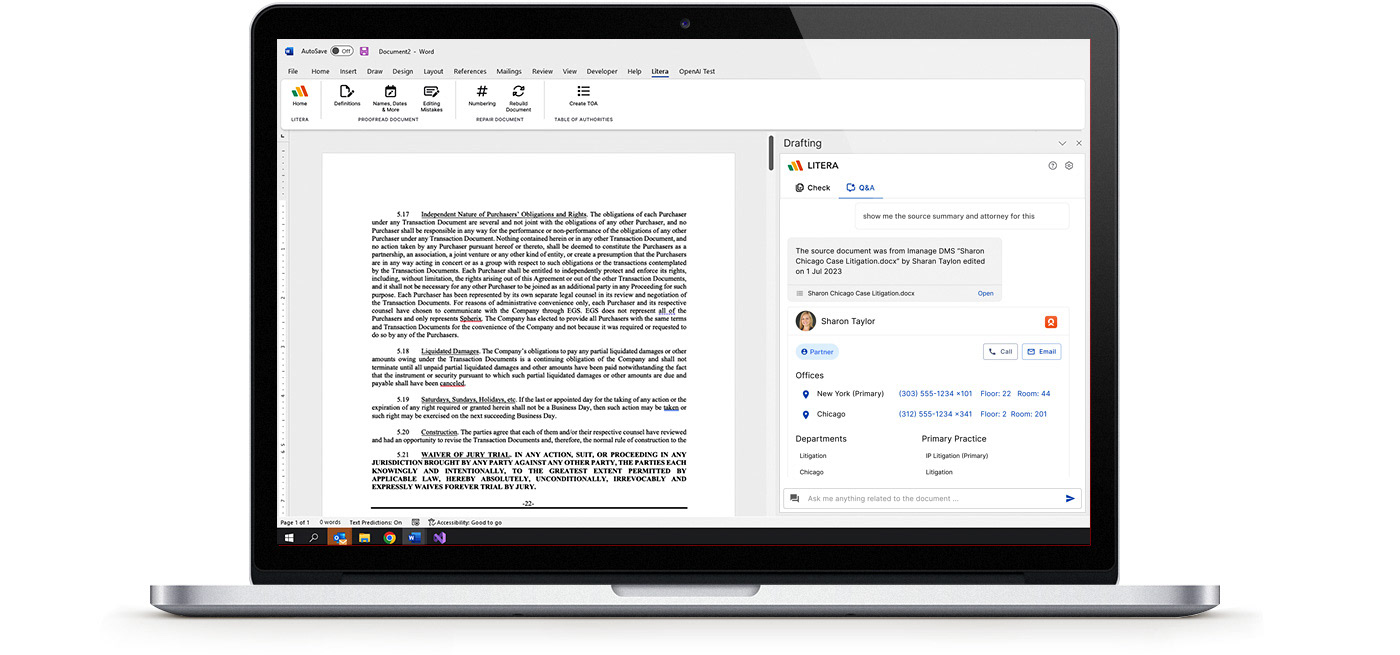
Litera is committed to moving all on-premise and legacy VSTO products to the cloud. The Nebula AI project will join the rest of the drafting products in a new unified drafting experience. Over the last 18 months my team and I have been discovering workflow efficiencies and designing this new add-in experience. All this while conducting multiple user testing/customer interviews, ensuring we deliver a user centred product that accelerates product adoption.
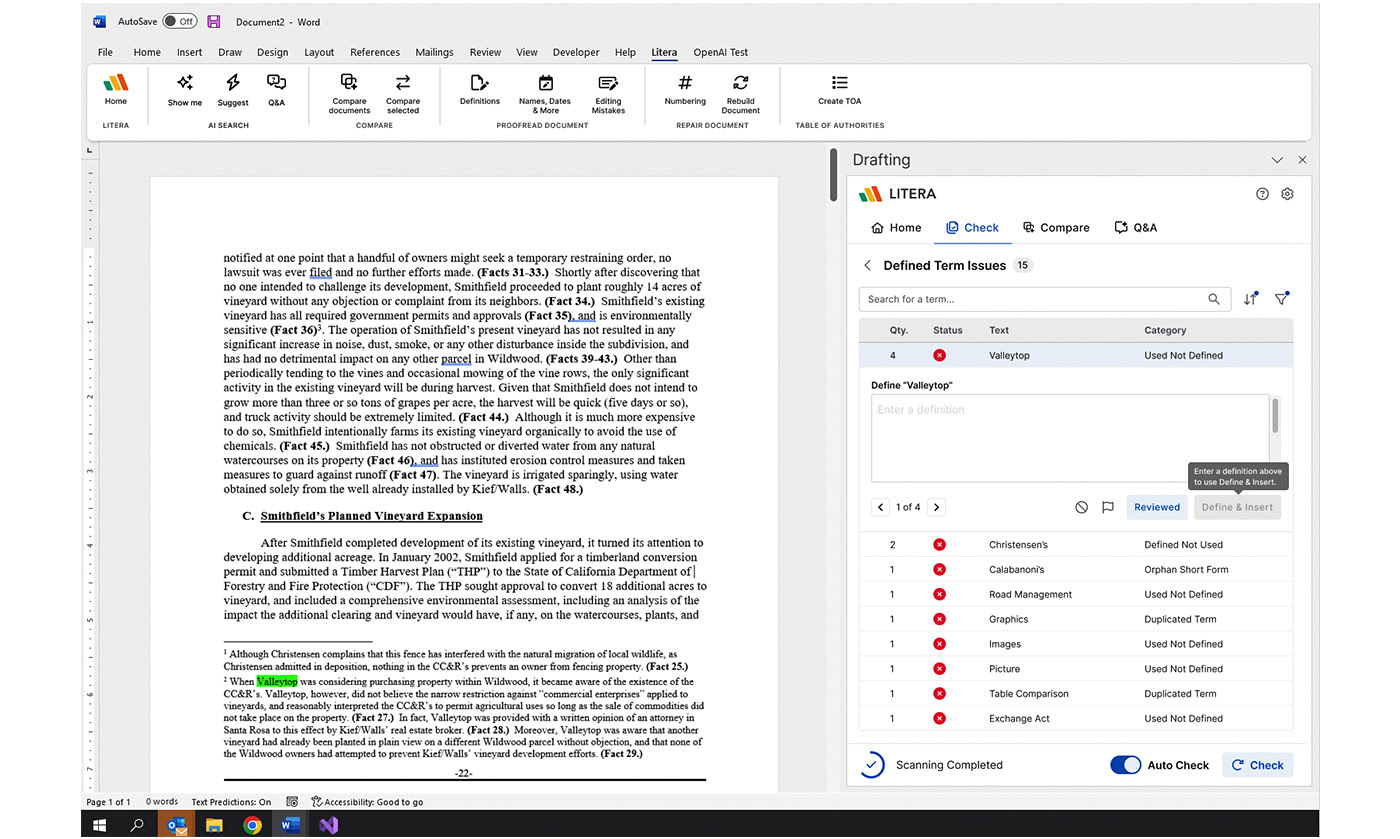
This new Add-in product uses the new Litera Design System (LDS) Find out more about this project here.
Nebula project specifics
The Team
Matt - VP of Drafting product
Dan - Lead Software Architect
Josie, Toby & Alister - Legal Knowledge Experts (LKE)
Jack - Senior UX Designer
Graham - UX Design Lead
Drafting a Contract
With 70% of Litera revenue coming from document drafting using Word plugins. How do we enhance the experience by implementing Generative AI?
Our user research found that writing a new contract always starts with finding the perfect precedent. Most large law firms utilise Document Management Systems (DMS) which stores all contracts current & past that the firm has worked on.
Trawling through the DMS finding the appropriate previous signed contract, known as precedent was a major pain point.
This usually consists of manually searching these huge DMS data stores for the right contract, clause or definition. Spearfishing for any embedded clauses or definitions is even trickier to accurately source. Users would resort to opening a contract in Word & doing a search (Ctrl+F) on specific words which may be in the document to validate it being a good precedent. A huge time waste.
An experienced partner lawyer would tend to use their experience finding a previously worked on contract that they know would suit. However, all too often it is a junior lawyer persona with limited experience of knowing this history that is doing this task.
Our Gen AI powered solution
Building a natural language search experience to find this specific precedent content nearly instantly
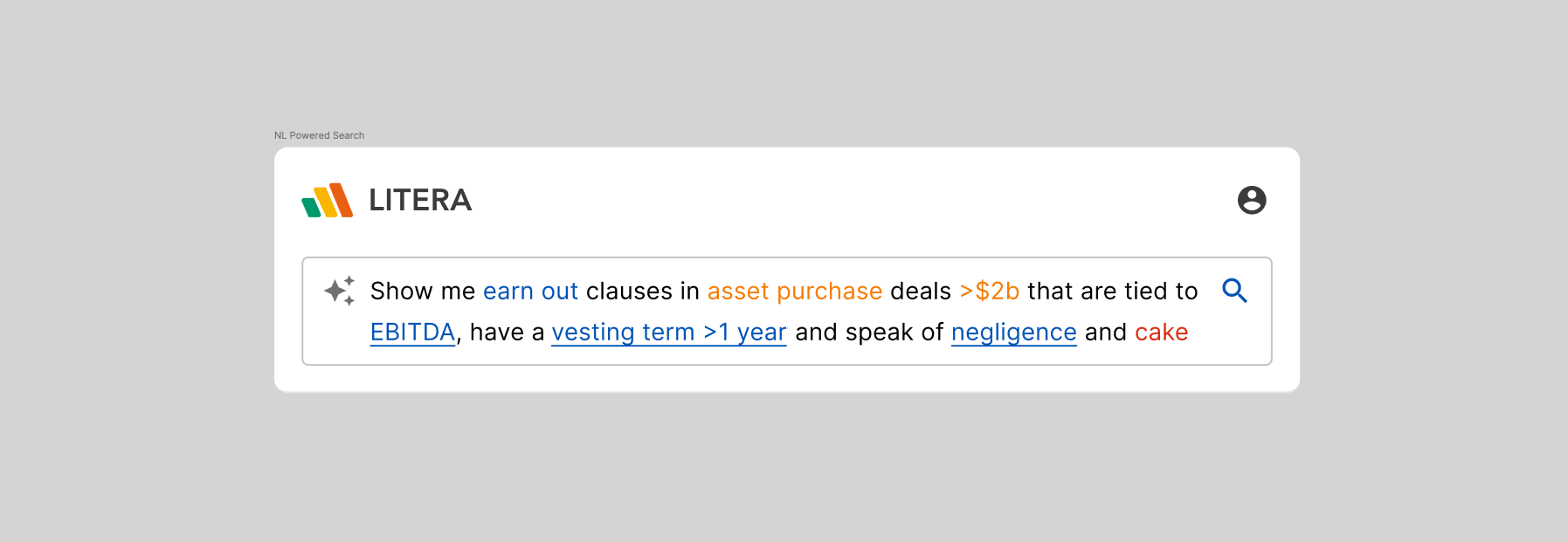
Users can use natural language to search for very specific content to use as their precedent. This would replace the tricky filter user interface pattern that was used in the previous Litera Recommend product that Nebula is built on.
Natural language - "a significant shift in how people interact with technology. AI and in particular search has evolved to better understand natural language queries making technology more accessible, useful and delivering more relevant information."
Quickly finding whats relevant is easy with useful search results. Users can view full text result and from which contracts it appears in. This gives the user full transparency & confidence in the source.
The user is then able to insert the content directly into their Word document with a single click.
Usability testing
Using Dovetail we engaged with 4 customers and 3 internal LKE's
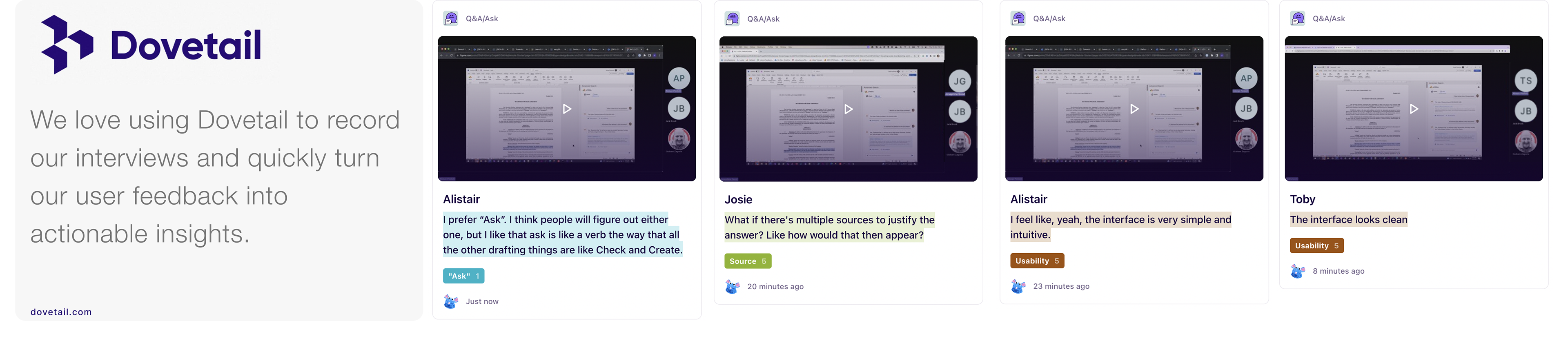
Important finding - Legal search terms can be very ambiguous and refer to multiple ideas. So not all search phrases will be literal.
Insights
- Natural language search for retrieval is far more intuitive than filtering using the old LRS (Litera Recommend Service) approach.
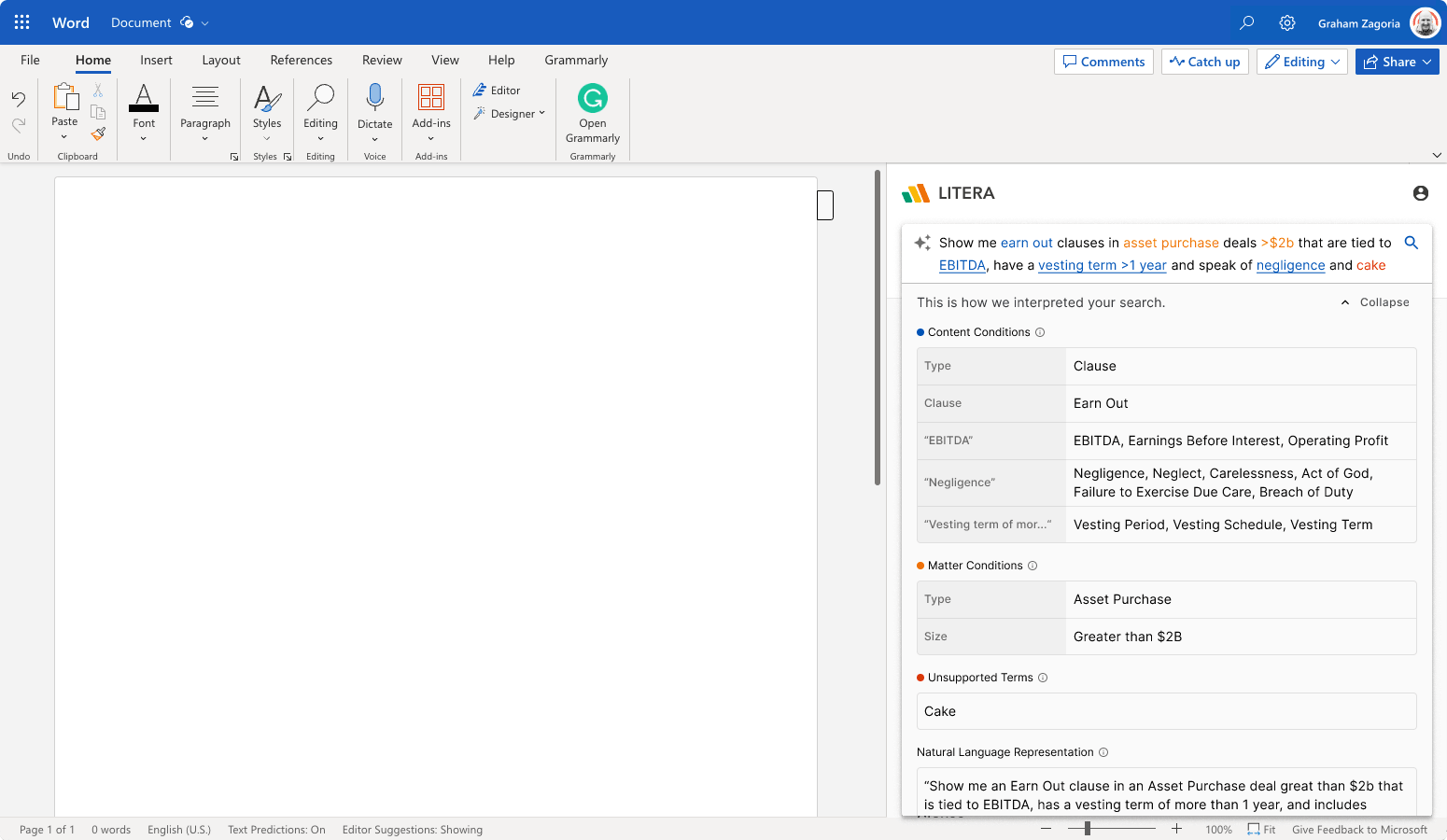
- Lawyers are skeptical and extremely detail oriented. Many expressed the need to see what the AI is doing behind the scenes when it runs its queries.
- Users also expressed the need for generating new content with AI. Not simply sourcing existing precedent.
Emerging problems
Ambiguous search terms - Legal terms can be ambiguous and reference multiple other terms.
Trusting AI - Detail oriented lawyers need reassurance. What is the AI actually doing.
Ambiguous search terms
How do we deliver relevant content if legal terms can mean multiple things?
Legal contracts often use abstract language that can refer to many concepts at the same time. This becomes particularly problematic in traditional search since users would need to look for each work individually.
Initial design explorations were problematic and tedious. Requiring the user to manually submit relevant synonyms. A far simpler solution needed to be discovered!
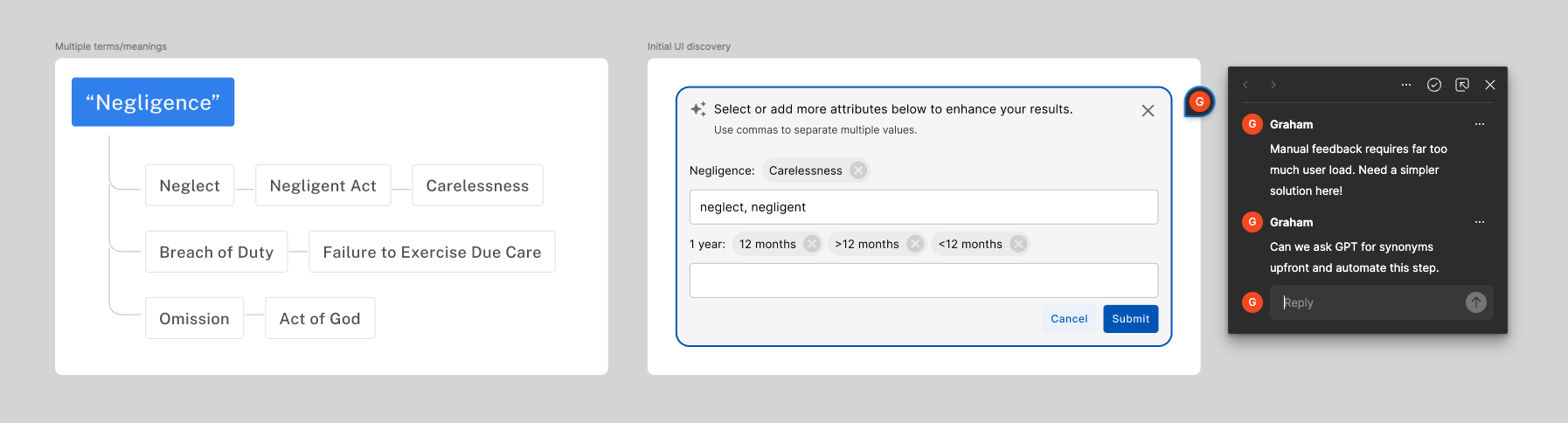
Our solution: Let's get AI to generate synonyms for us.
So instead of asking the user to think of and apply multiple synonyms we get GPT4 to deliver these beforehand. Automating and streamlining this process with AI was the way forward. The tests we conducted were extremely accurate and approved by our LKE team.
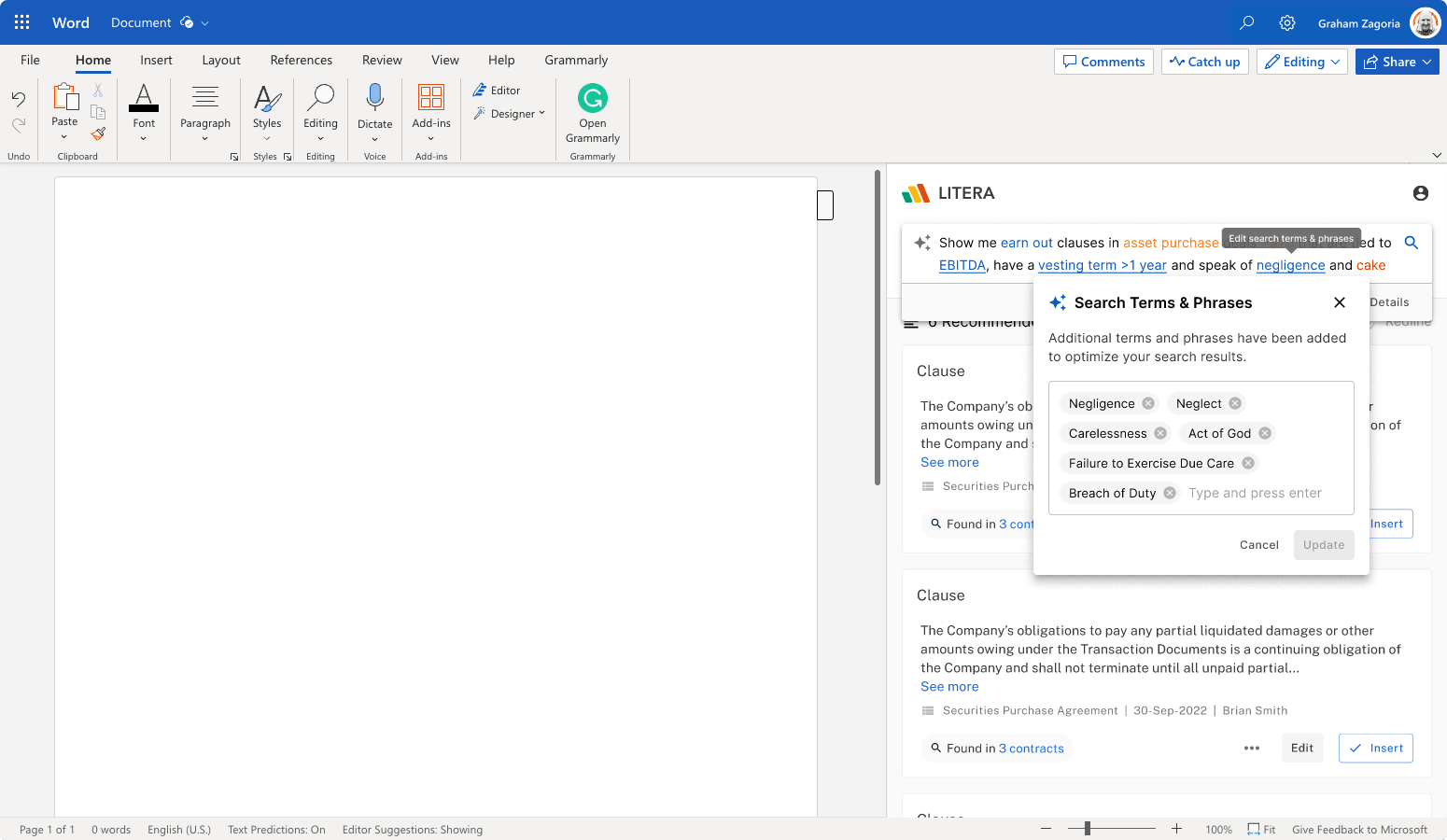
Once the user had run the NL search the LLM detects words that are ambiguous. These words are highlighted in the search string. Clicking on them would open a new component card displaying the generated synonyms.
Validating these is easy. Simply click to remove irrelevant synonyms and add new ones. Updated results are delivered far quicker than the original search.
Building trust
Our research told us that lawyers are very detail oriented and would want to know how the LLM was interpreting & parsing their queries. Displaying results with search interpretation not only helps build trust with the users, allowing them to self-diagnose undesirable search results but also provides functionality not available with any competitor.
Retrospective
Overall the project was a resounding success. Below are some takeaways from the project:
Finding accurate content quicker. Users were impressed by the LLMs ability to interpret specific NL search requests and return applicable precedent. Solving a major pain-point in their day to day workflow.
Litera proved to be strong innovators and received praise from the alpha testers for delivering a relevant new AI product that improved their workflow immensely.
Working fast with a small team meant we could ideate and ship new ideas quickly to alpha customers. Successfully advocating for the user allowed the experience to stay intuitive and usable.
Designing for new technology is challenging. It requires being nimble, learning, testing & training the team and users to utilise the power of AI.